Showing posts with label Wikipedia. Show all posts

Friday, March 17, 2017

Wikipedia Trail: From Callanish To Dolmens

1. Callanish
The word Callanish is derived from Scotland and is situated in the Western side. This place is famous for stones that were erected 3000 BC. It is known to be a megalithic monument. This reminds me of the rock finger in Namibia.

2. megalithic
 Megalithic refers to rocks or other large structures that form on their own and that is not built, using construction equipment. The word is derived from the Greek language, where 'mega' means great and 'lithos' mean stone. There are many megaliths around the world. Examples include the Middle east and Turkey.

3. Portal Tomb 
A portal tomb found in Europe is known as a portal tomb or a "dolmen". This specific portal tomb is a single-cavity which consists of two or more structures to support a table. It reminds me of a dinner table.

4. Dolmen Types:
There are five different types of Dolmens and each has their own link on Wikipedia, so it is too much information to list. I will have to spend more time to read up on this. I found this Wikipedia Trail to be very interesting and it reminded me of tourist attractions back home. 


A Photo Of A Dolmen. Source:Wikipedia


Monday, March 6, 2017

Wikipedia Trail: From Zen To Tang Dynasty

1. Zen
Zen is a school associated with Buddhism. It originated in China and was higly influenced by Taoism. Zen's roots also go way back to Dhyana among the Indian community.

2. Taoism
There is a difference between Tao and Taoism. Taoism denotes the idea that everything in the universe exists and has an immense influence on people all over the world.

3. Confucianism
Confucianism is different than Taoism and it highly influences China, Hong Kong, Japan, etc. There is so much to learn about this, tat I will have to go back and read more about this concept. I once had a professor who was a Buddhist and he used to talk a lot about this.

4. Tang Dynasty
The Li family founded the Tang Dynasty and was considered a period of firmness, strength. The Wikipedia article about the Tang Dynasty has so much information and it is quite confusing. I am glad that I picked the topic of Zen to strart with, but I feel like I did not get as good information as I would have hoped for. 

Tuesday, January 31, 2017

Wikipedia Trail: From Batu Caves To Monks

1. Batu Caves
Wow! This picture definitely caught my attention and that is why I decided to choose this as my Wikipedia trail name is derived from the Batu River, which flows past the hill. Batu Caves is also named after the villages that is close to it. It is dedicated to a lord who is named Murugan.

2.  Murugan
Murugan also goes by the name Skanda, among others. He is an indigenous war god. He has six shrines, which literally means "six warhouses". An account of his birth can be found in Mahabharata. There is a lot of information regarding his birth which was very long and I would have to spend more time on this.

3. Tonsure
Latin word meaning to cut or shave some or all of the hair on a scalp. This religious sign is shows devotion and humility. It is very common in Hinduism and Buddhism and represents something meaningful in both religions. It is however banned in Islam.

4. Monks
Monks are sometimes referred to as Bhikkhu. Anyone who is younger may not become a monk, but they may become a śrāmaṇera. The word Bhikkhu means beggar. The Wikipedia article that I read was very interesting and gave so much detail, that it was almost overwhelming.

(Bhikkhu sitting on a bench. Source:freegreatpicture)

Monday, January 23, 2017

Wikipedia Trail: From Devata To Mandala

I found a classroom tweet by Professor Gi

1. Devata: 

A Devata is known in the Hindu religion as a deity or a god and they come in many sizes, regions and categories. There are Devatas for mountains, caves,  rivers, cardinal points and can even be found for seducing people.


Three Devatas. Source: Wikipedia 


2. Angkor Wat:
 Angkor Wat is found in Cambodia, which is located in the Southern Peninsula off of South East Asia. Before it turned into what is now called a Buddhist temple, it was constructed for Vishnu (a supreme god) as a Hindu temple. Angkor what is now known as the 'temple city' and was built in the 12th century
Front side of main complex
 A Photo Of Angkor Wat. Source: Wikipedia


3.  Mount Meru:
Meru is called many different things in among the Sanskrit and was built to represent symbolic meaning. I found this very interesting, because they explain how the Hindu, Buddhist, Jain and Javanese legends view Meru.
https://upload.wikimedia.org/wikipedia/commons/1/1b/A_Korean_world_map_centered_on_the_legendary_Mount_Meru_in_Central_Asia..jpg
Picture Of Where Koreans Place Mount Meru. Source: Wikipedia


4. Mandala: 
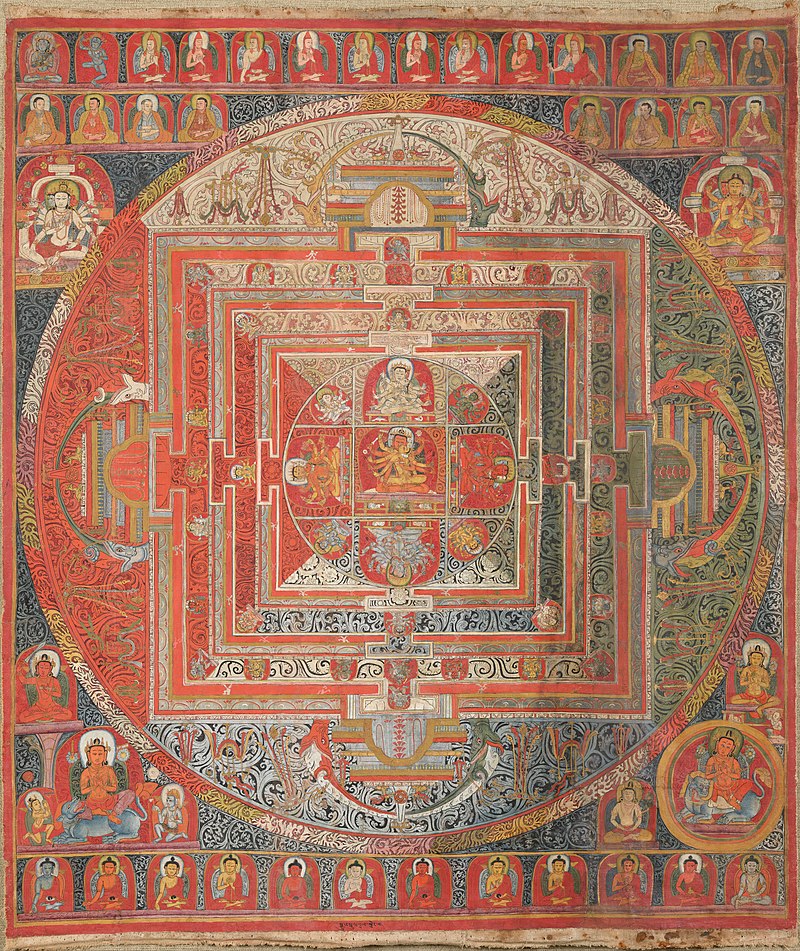
I decided to click on the Mandal link, because it sounds very similar to Mandela. It has both a religious and political meaning in Hinduism, which I would have to spend more time on, in order to fully comprehend. It is mentioned in the article that it can represent Mount Meru, which in turn represent the entire universe. Amazing how one link plays off of the next...is it not?

 The Mandala Painting. Source: Wikipedia